Saturday, April 4, 2015

Lunar Eclipse from the City


Click on image for a larger view
It all started when fellow Astronomical Society of Kansas City member, Jay Manifold, mentioned at our monthly meeting, that he found a place not too far east of downtown Kansas City, MO where the eclipsing moon would be setting along the Kansas City Skyline. I did my own research by locating the small nameless park in Google Earth. A Google street view looked promising, so with that, some NASA info on the April 4, 2015 eclipse and a program called "The Photographer's Ephemeris", I determined approximately where the moon would be among the buildings. With Jay's help, I found the names of the buildings and created the daytime view you see above.

Among the dozens of image I took, this one combines the not quite eclipsed moon, with the KC Skyline in a beautiful, dark blue twilight sky.

 The sky was so clear that we saw it go behind the 925 Grand building. The tall building at right is the 909 Walnut and the one in front is the Federal Courthouse. It's interesting to note that if the moon was totally eclipse, we may not have seen it. What we saw was the last bit of moon peeking out from behind earth's shadow. In Kansas City, the moon was totally eclipsed after it set behind the buildings.


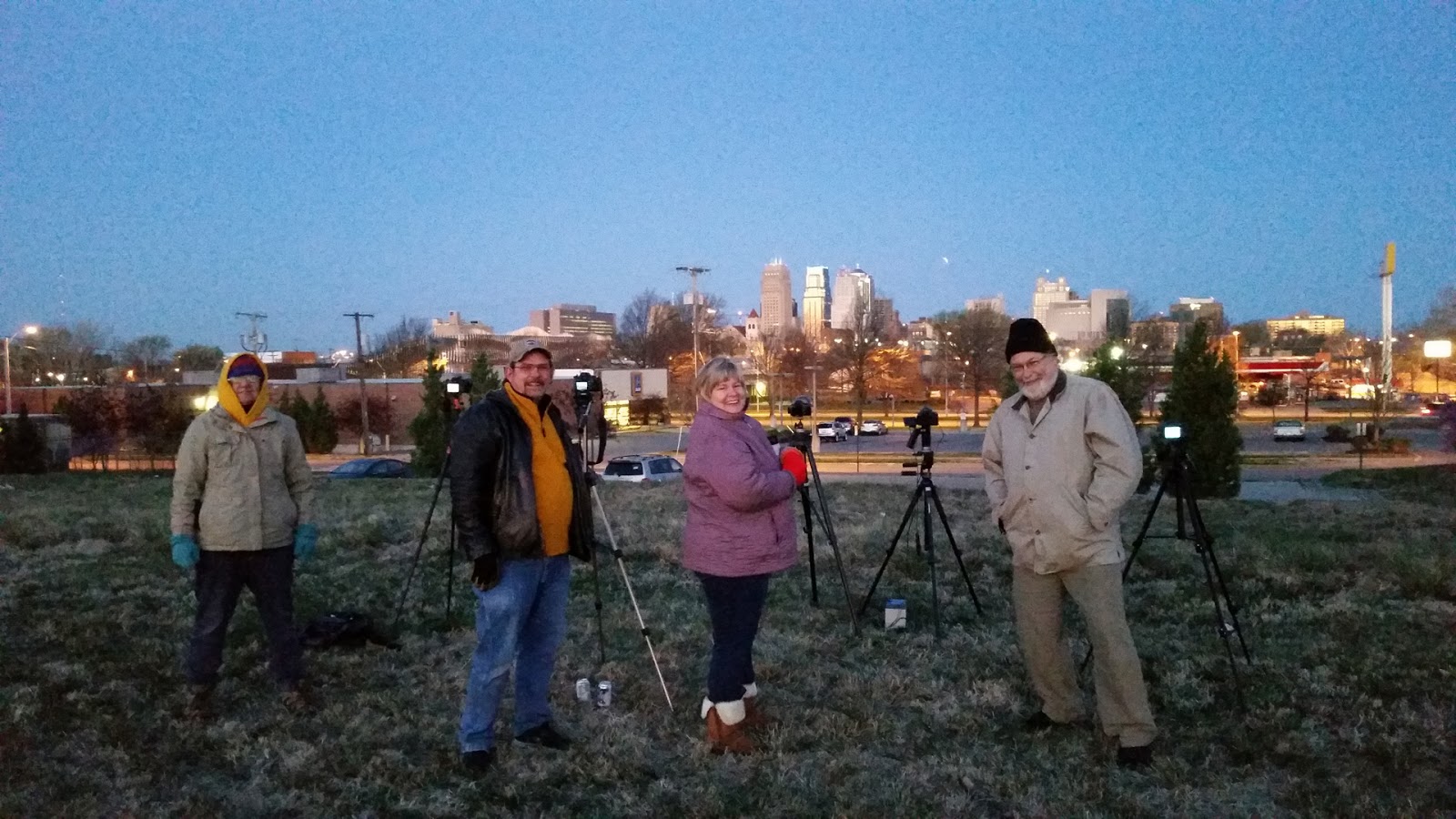
Clif Guy took this nice shot of the group. From left to right, Jay Manifold, Sam Davidson, Don and Terri Dixon, Denise Moser and myself. It was just above the freezing point and quite chilly.
Denise, Don, Terri and Jay. Good view from the little grassy knoll.

The angle in the photo by Terri Dixon shows my camera in the foreground making it look twice as big as it really is! Clif Guy an Jay Manifold in the background.

Soon after the moon was gone, everyone took off for breakfast. I love a good breakfast with good company, but I wanted to hang around for the "Golden hour". Soon after the sun rises it shines a golden light over everything. As I was packing up to go home, a very nice man in a uniform came over and told me that I wasn't supposed to be there. The property belongs to the University (UMKC?), but he thought I was just taking photos of the skyline and didn't bother me until I was done. We talked for bit about eclipses and then he drove off. Apparently the University does not want people hanging around their little park.


Monday, March 23, 2015

Crescent Moon, Venus and Pleiades

Click on Image for a larger view

The planet Venus was a wonderful site next to the crescent Moon this evening, March 22, 2015. This is a view from my backyard. The Pleiades Star Cluster is at the top.

I my Canon T4i on a tripod and used my 18 mm - 135 mm lens set at 18 mm and f/3.5 and ISO 1600 for 10 seconds.


This one was taken with my 300mm f/4 lens set at f/8 for 2 seconds at 800 ISO. I used my iOptron SkyTracker on a tripod to track the pair so that I was assured of a sharper image.

Sunday, January 18, 2015

Comet Lovejoy near the Plieades


A few days ago I set up my camera with my 70-200 Canon lens on my iOptron Sky Tracker and took 418 30-second images in about 4 hours. Out of those 418 I used 98 to put together the above image. On that day, Jan 16, 2015, it was near the Plieades Star Cluster. I was pleasantly surprised to get the nebulosity that surrounds these beautiful cluster.

Saturday, December 6, 2014

Cloud Iridescence

A fairly uncommon phenomenon is "Cloud Iridescence". I noticed this while watching my son-in-law, Brad, put up some Christmas lights on the roof of his house the day after Thanksgiving. The colors you see are a diffraction of the Sun's light passing through small water or ice droplets. Usually near the Sun, so I had to block the Sun with the roof top, otherwise the Sun's glare would overwhelm the effect. Brad was so intent on his chore that I don't think he was ever aware of the colorful site behind him.

Click on image for a larger view
Adjusting the image by reducing the highlights and increasing the detail in the shadows and reducing the exposure in software such as LightRoom brings out detail and color a bit better:


Monday, November 10, 2014

Heart Of America Star Party 2014

Another great Heart Of America Star Party has come and gone. Check out the website at HOASP.com. This yearly star party has been a great success for the Astronomical Society of Kansas City ever since it started in 2007. This year I did something I've been wanting to do for a while. I created a time lapse video of the event. On Thursday the night was too cloudy to shoot, but we got some great nights on Friday, Saturday and Sunday. Here is the video, which is best seen on a big monitor, full screen, speakers on and at the high resolution of 1080p (click on the little gear icon at the lower right of the video to change the resolution):


https://www.youtube.com/watch?v=zoeHr0GhVjo

My good friend, and astrophotographer, John Reed, also shot a time lapse and I have included it into the video. John is a member of the Central Arkansas Astronomical Society and has some really nice images taken with fairly simple equipment.  You can see his work here: Photography In The Dark.

On Saturday night, the clearest night of all three, I ran into a humidity problem. Anyone who gets into this hobby runs into this right away, especially if they live in the Mid West. Practically every night, the dew gets everything soaking wet. To keep the moisture off the lens of my camera, I use a heating strap that I made from a few resistors, wrapped in velcro. The dew heater gets its power from a 12 volt, 28 amp battery, which also gives power to my camera and time lapse rail by Dynamic Perception. As you can see in the video for the night of Oct 25, humidity crept in and started fogging the images. Unknown to me, the dew heater around my lens was not working (broken wire). Even so, what would normally be a bunch of deleted pictures, I decided to keep them and create the video anyway. I was pleasantly surprised with the soft quality it gives to the show. I replaced the broken dew heater with another one for the the next night.

On Sunday night, most everyone had gone home, since the star party was officially over. I decided to stay since it was supposed to be clear. I set up my time lapse equipment next to Master Observer Scott Kranz with his scope in the foreground, hoping to get him in action. But Scott was no where to be seen and you can see his telescope covered up in the video. Never the less, a nice crescent moon was a treat during the very windy twilight hours. The Milky Way set in the West just before clouds came in and ruined the rest of the night.

Our hobby is somewhat like fishing. We set up our telescopes in hopes of a good catch of starlight on a clear night, but sometimes we catch nothing because of clouds.

Monday, October 20, 2014

Thursday, October 16, 2014

Lunar Eclipse - Oct 8, 2014

Click on the image for a larger view
October 8, 2014, about 2 a.m., Gloria and I drove to Hillsdale Lake, KS, about a 20 minute drive from my home in Cleveland, MO. I set up my time lapse equipment and two tripods with my cameras to take pictures of the second Lunar Eclipse of the year. Clouds were lying low in the southwest, but clear over the rest of the sky and the Full Moon was shining brightly. At 4:17 a.m., the first bite from the shadow of the earth was taking place. Slowly, as the sky got darker, and more and more of the moon was being eclipsed by earth's shadow, we watched the stars appear above us.

Around 5:25, the moon turned to a beautiful, red ocher, brighter on one side, this being due to the fact that the moon did not go through the exact center of the earth's shadow. The picture above was taken with my 300mm f/4 Canon lens and Canon Xti. It is actually two images combined to show what it looked like in my binoculars. The planet Uranus was easily visible in binoculars. The picture of the moon was 4 seconds at ISO 400 and the stars were shot for 15 seconds. It is impossible to show this with one shot, so combining them is the only way.


Above, is the view across the lake, take with my 18mm f/3.5 Canon lens and the same Xti Canon camera. The exposure was 10 seconds at ISO 1600. This is also a double exposure, with the moon exposed for 10 seconds, but with the ISO at 200, essentially 3 stops slower.


This image is one taken from the set of time lapse pictures. The exposure for this shot was 25 seconds with a 10mm f/3.5 lens and my Canon T4i at ISO 3200. The longer exposure and higher ISO setting bring out many more stars, including the Andromeda galaxy at upper right.

A truly wonderful night. The only thing I could hear was an occasional fish jumping in the lake. At one point I watched a raccoon walk along the edge of the lake not noticing me, until I moved slightly, then it scooted into the bushes.

The next Lunar Eclipse will occur September 28, 2015.